Sip & Savor
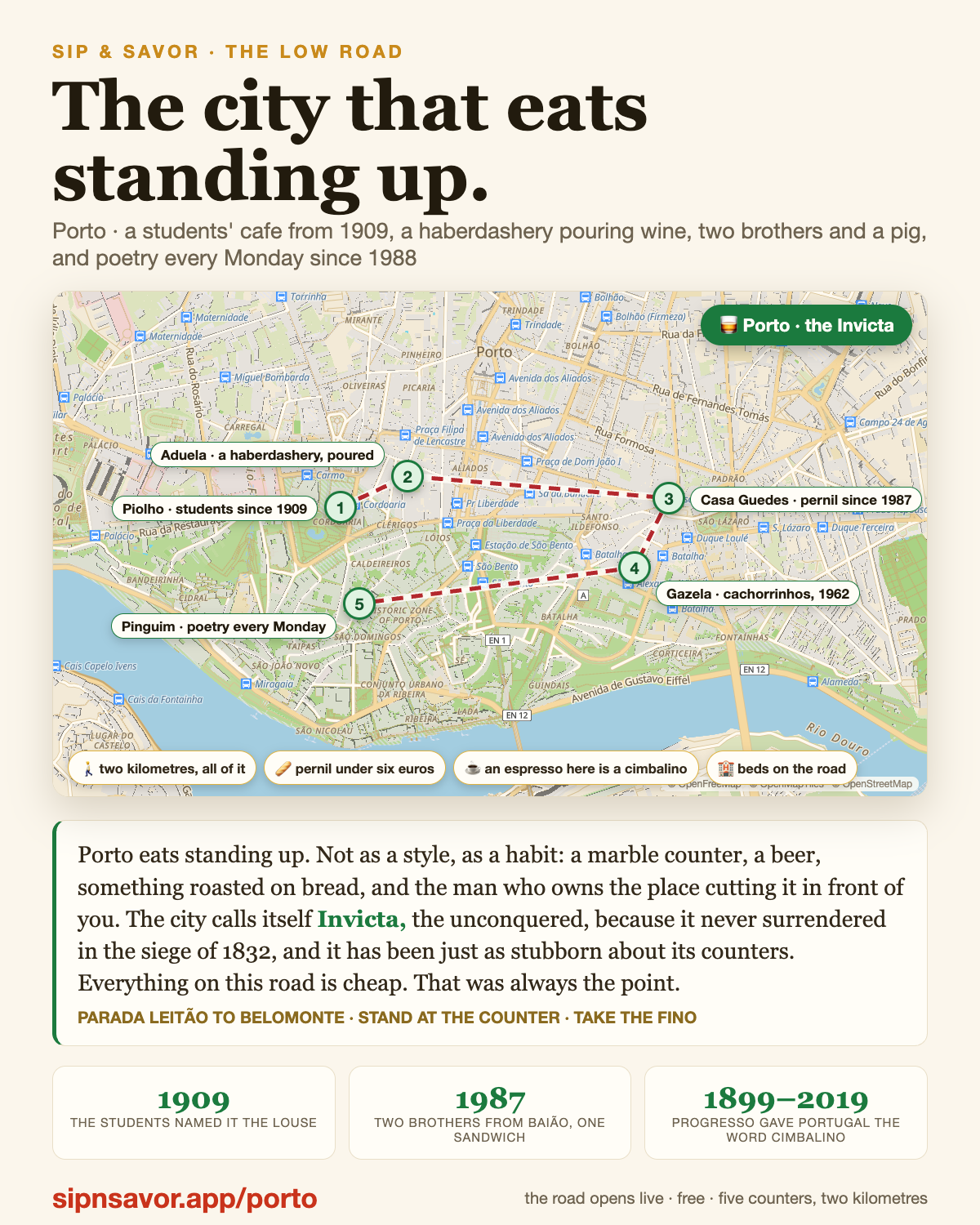
The Low Road: The Invicta Standing Order
Porto · 5 stops · every stop verified in live map data · ends near a bed
Porto eats standing up and keeps a legal register of the shops that let it. Three of these five are on it and unflagged as of July, which is a better proof of life than any website. Two are not, and one of those we could not prove is open at all.
🥃 Walk it live on the map- 1 · The Cold Open
Café Âncora d'Ouro, o PiolhoEverybody calls it o Piolho, the louse, and nobody agrees why: the crush of students, or the market women, or a remark by somebody refined. The 26 June we print is not a 1909 record. It is the day chosen for the centenary act in 2009, when the student federation put a plaque up; an alumni magazine printed it, Wikipedia cited the magazine, and the national register copied it from there. The house's own centenary book says only 1909. Order a cimbalino, Porto's word for an espresso, and a fino, Porto's word for a small draught. It runs to four in the morning. - 2 · The Detour
Cervejaria GazelaThree cervejarias opened in the sixties named after African animals, Gazela, Impala and Corsa, and only this one is left. Américo Pinto started here as a boy and bought it in 1981. The cachorrinho is a small crusty roll split and filled with fresh sausage and flamengo cheese, brushed with butter cut with piri-piri, pressed on the grill and then cut across into pieces. The butter is the guarded part and they will not tell you. Eat it standing at the half-moon counter with fries and a fino. There are three houses now and this pin is the original. - 3 · The Anchor
Casa Guedes, Praça dos PoveirosThe Correia brothers did not found this. In 1987 they bought a going concern called the Snack Bar Guedes, and nobody can tell us when that one started. César and Manuel built it into five houses across the city, and the group has since been sold to Brazilian buyers behind the Botecos Belmonte chain in Rio. Order the sandes de pernil, slow roasted pork leg in house bread, and take the number eight with soft sheep's cheese, which melts into the hot meat as you hold it. No bookings, at any of the five, ever. - 4 · The Wildcard
AduelaAn old sewing machine warehouse, not the haberdashery we had written, opened as a taberna in December 2012. An aduela is a barrel stave. It is the wettest room on this road and the least interested in being old: Portuguese wine by the glass is the order, with tremoços and salpicão and a tosta de presunto to hold it down. It is also the one stop here we could not prove is trading. No entry in the city register, nothing operator-dated since May of last year, and the socials behind a login wall. Ring before you count on it. - 5 · The Last Call
Pinguim CaféLuís Carlos and his wife Fernanda opened it in 1987 and the poetry began in 1988, inaugurated by Joaquim Castro Caldas. It faded in the late nineties and came back around 2000, so the unbroken line is not quite unbroken. Paulo Pires ran the place for twenty five years and died in 2023; it managed itself for a while after that, and the actor Rui Spranger took it on in March 2025. The tables have slate tops and you can ask for chalk. Monday is poetry. Happy hour is five till eight and it goes to two.
🎁 The one that did not survive the rent. Café Progresso opened on 24 September 1899 and was the oldest café in the city, famous for its toasts and for serving some of Porto's first espresso off a La Cimbali machine, which is why an espresso here is still called a cimbalino and nowhere else in Portugal says it. It was bought by a Lisbon restaurant group in 2019, then closed. The room did not die: Casa Guedes took the keys, so the pernil now comes out of the building that gave Portugal a word. That second house has three floors, terraces and a cocktail list. Go there to sit down. Go to the counter on Poveiros for the sandwich.
Fly in via OPO. The live map shows every pub, bar and restaurant around the route, compiled from OpenStreetMap and Google with live ratings.